How to Reduce Technical Debt in 2026: 9 Proven Strategies
A tactical paydown playbook for reducing technical debt in 2026: 9 strategies including debt budgets, refactoring at scale, automation, and prevention gates that survive roadmap pressure.

A tactical paydown playbook for reducing technical debt in 2026: 9 strategies including debt budgets, refactoring at scale, automation, and prevention gates that survive roadmap pressure.
Every engineer knows how to reduce technical debt in the abstract: write tests, refactor, keep things clean. The reason debt keeps winning isn't ignorance of the techniques. It's that the techniques lose the prioritization fight to feature work, every sprint, until a system gets scary enough to force a rewrite. Reducing debt for real is less about knowing what to do and more about building a system where the doing actually happens.
This guide is the tactical layer for engineers and tech leads who already know debt is a problem and need a paydown playbook that survives roadmap pressure. Nine strategies, ordered roughly from "do this first" to "do this once the basics are in place," each grounded in what actually moves the needle at scale.
The honest reason debt accumulates is that the trade is usually rational in the moment. Shipping a shortcut to hit a launch is often the right call, and the technical debt management literature agrees that zero debt is the wrong goal. McKinsey's research puts it plainly: almost every business carries some debt, and the trick is to identify, value, and manage it rather than chase a zero. The problem isn't taking on debt. It's taking it on without a repayment plan, so the interest compounds invisibly until it shows up as an incident or a quarter of mysteriously slow delivery.
That invisibility is the core obstacle. A debt ticket with no business case attached loses to a feature with a revenue number every time. The most upvoted advice from practitioners on this exact question is consistent: stop arguing that debt is bad in principle and start proving it costs money. Has this debt caused incidents? Is it measurably slowing delivery in a specific service? Frame the reduction work in those terms, and it stops being a faith-based request. Every strategy below is, in part, a way to make the cost of the debt sufficiently visible to fund its fixing.
You can't reduce what you can't see, so before any strategy, get a real inventory. The audit-document approach goes stale the week you finish it; the durable version is a set of queries you can re-run. We go deep on this in our guide to measuring technical debt, but the short version: turn each debt item into a search, count it, and watch the trend.
This also tells you which debt to reduce first. Not all of it is worth paying down, and the types of technical debt differ wildly in interest rate. Architecture debt in a frozen module can be left alone; the same debt in your highest-churn service is bleeding you weekly. Size by interest, not by how alarming the principal looks.
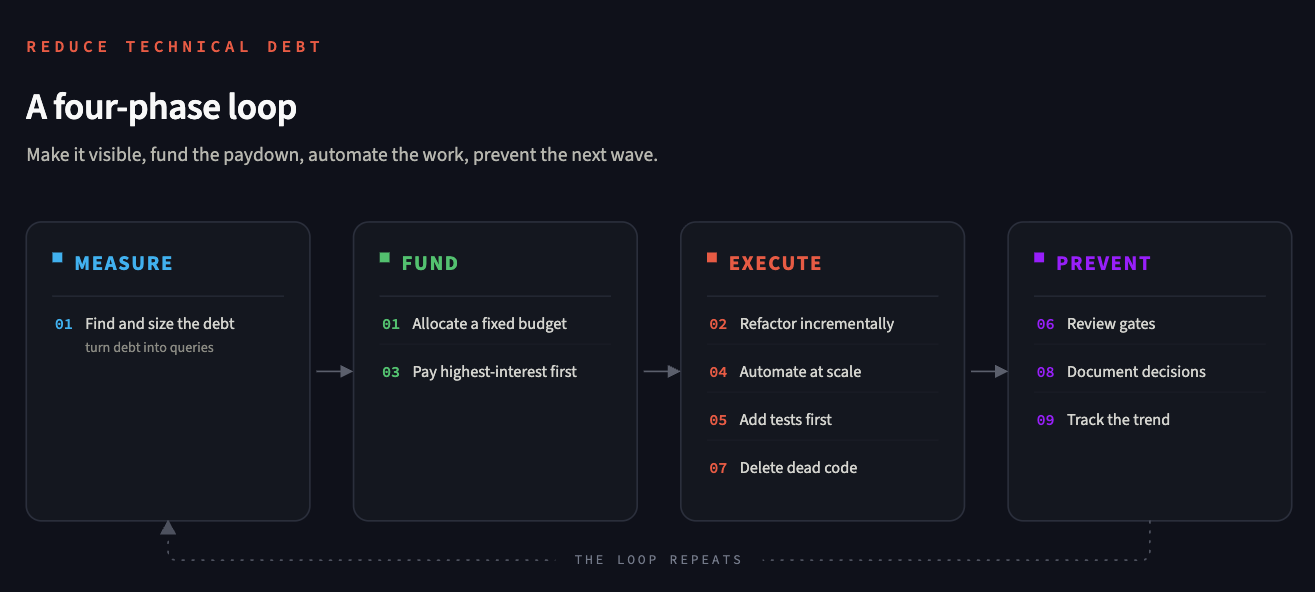
The nine strategies map to a repeating four-phase loop: measure the debt, fund the paydown, execute the fixes, and prevent the next wave.
This is the single highest-leverage move. A standing allocation of capacity to debt reduction outperforms the occasional "refactoring sprint" because it survives roadmap negotiation. A fixed, predictable allocation matters more than the exact percentage; many teams use something in the 10% to 30% range, depending on roadmap pressure and risk, and one practitioner framing runs roughly 30% debt reduction, 50-60% features, and the rest immediate support. A budget you can defend every quarter beats a heroic binge you fight for once a year.
This is also the move with the most organizational research behind it. Carnegie Mellon's Software Engineering Institute, in its recommendations for managing technical debt, frames debt reduction as a standing practice backed by policy, visibility, and ongoing metrics rather than a one-off campaign. The budget is what turns that recommendation from a slide into a calendar entry. A practical way to make it stick: tie the allocation to the trend from strategy #9, so each quarter's renewal is a data point, not a debate.
Big-bang rewrites are how debt-reduction programs become cautionary tales. The reliable alternative is small, behavior-preserving steps, the same discipline Martin Fowler describes when he notes that refactoring first to make a change easy is usually faster than forcing the change into messy code. Reduce debt in slices small enough to ship and reverse, and the program survives the inevitable mid-flight surprise.
This is the 80/20 rule applied to debt: a small fraction of items causes most of the pain. Find the code that is both high-complexity and high-churn, because that intersection is where defects and slowdowns concentrate. Paying down a tiny, ugly, constantly-changing module beats paying down a huge, ugly, dormant one every time, even though the dormant one looks scarier in an audit.
When the fix is mechanical, like replacing a deprecated client or bumping a version across services, doing it by hand across dozens of repos is how the work stalls. Batch Changes applies a single declarative change across all affected repositories and tracks the resulting pull requests from review through merge. The same approach handles security debt: when Log4j hit, Nutanix used Sourcegraph to find and fix every instance. For the Log4j 1.x case, they saw where the vulnerable JMSAppender existed, fixed it, and shipped a release in under five minutes; a few queries identified every instance across the codebase within a couple of days; and fully remediated patches reached customers within four days, with confidence they'd caught 100% of instances. That speed is only possible when finding and changing code is query-driven rather than a manual hunt.
Reducing debt without a test safety net isn't refactoring, it's gambling. For legacy code with no tests, write characterization tests first that pin down what the code currently does, quirks included, so any unintended behavior changes surface immediately. The test debt has to be paid before the other debt can be paid safely, which is why it sits this high on the list despite feeling like a detour.
Reduction without prevention is bailing a leaky boat. Make "no new debt of this type" a review gate: block the deprecated pattern you're trying to eliminate, require tests on changed code, and keep refactors in separate pull requests from behavior changes so reviewers can actually verify them. The cheapest debt to reduce is the debt that never enters the codebase.
A surprising share of debt is just stuff that should be deleted. Unused feature flags, dead code paths, dependencies nobody imports anymore. This is the highest-return reduction work because deletion has no regression surface once you've confirmed that nothing uses the code, and Code Search makes that confirmation a query rather than a guess across every repository at once.
Much inadvertent debt comes from lost context: the engineer who knew why the reconciliation job worked that way has left, so the next person reimplements the bug. Lightweight decision records and current docs keep that knowledge in the codebase. In the AI era, this pays double, since coding agents lean on the same docs humans do.
The final strategy closes the loop. A reduction program without a scoreboard quietly reverts. Code Insights turns your debt queries into trended metrics, so "callers of the deprecated client" becomes a chart that should only go down, reviewed at the same cadence as delivery metrics. The trend is also your renewal argument: "We cut the deprecated-API count from 4,100 to 900 last quarter" is how you keep the budget from strategy #1.
The objection to every debt-reduction plan is the same: we can't stop shipping features. You shouldn't, and the good strategies above are built so you don't have to. Three mechanics make paydown and delivery coexist.
First, attach paydown to feature work. If a team is already shipping a change to the billing service, the refactor of that service rides along at a discount because the cost of loading the context has already been paid. The most efficient debt reduction happens in code you were going to touch anyway.
Second, keep the budget small and constant rather than large and occasional. A steady 15-20% allocation barely dents feature velocity and compounds over a year, while a "debt quarter" stops feature work entirely and breeds organizational resistance to ever doing it again.
Third, let automation absorb the bulk of the work. The reason debt reduction feels like it competes with features is that, done manually, it consumes senior-engineer hours. When a cross-repo change is a reviewed spec rather than 60 hand-edited pull requests, the human cost drops to the parts that actually require judgment, and the competition with feature work mostly disappears.
A worked sequence shows how the three combine. Suppose your inventory flags a deprecated logging client in 4,100 references across 60 services. You don't pause the roadmap. The two teams already shipping in those services that quarter migrate their own usages as part of their feature work (mechanic one). A standing 15% debt budget covers the services with no active feature work (mechanic two). And a single Batch Changes spec handles the mechanical bulk across the remaining repos, turning what would have been weeks of hand-editing into one reviewed change with a tracked merge queue (mechanic three). Feature delivery never stopped, and the deprecated-client count continued to decline from 4,100 toward zero.
AI cuts both ways on debt, and pretending otherwise sells the wrong plan. On the intake side, code generation can increase the volume of new code, and with it, the volume of inadvertent debt if review and measurement don't scale accordingly. The risk is sharpest for the prudent-deliberate "we'll clean up the generated scaffolding later" kind, which only stays prudent if someone writes down the cleanup.
On the paydown side, AI genuinely helps where the work was always mechanical reading and rewriting: summarizing an unfamiliar module before you refactor it, drafting the characterization tests from strategy #5, proposing a refactor for human review. What it doesn't change is the need for ground truth. A model can suggest a fix; only a query against the actual codebase can confirm how many services still call the thing you're removing. The teams reducing debt well in 2026 pair generation with verification, letting AI propose and the codebase data confirm, which keeps the SEI guidance intact: debt reduction is a standing, measured practice, not a one-time AI-assisted cleanup.
The nine strategies share a spine: make the debt visible, fund its paydown predictably, automate the mechanical part, and prevent the next wave. Teams that reduce debt successfully don't run bigger cleanups; they run a steady loop that pays down high-interest debt while features keep shipping. The willpower-driven "refactoring quarter" loses to that loop every time.
If your debt-reduction work keeps stalling at the repository boundary, start with the automation layer. See how Batch Changes turns a cross-repo paydown into a single reviewed change instead of dozens of manual changes.
What can we do to reduce technical debt? Start with the highest-leverage moves: allocate a standing budget, identify and size the debt in the codebase, pay down the high-interest items first, and automate mechanical fixes across repos. Pair every reduction strategy with a prevention gate so you don't refill the bucket as you empty it.
What is the 80/20 rule for technical debt? A small share of debt items causes most of the cost. In reduction terms, it means you get the most benefit by targeting the high-churn, high-complexity hotspots first rather than trying to clean everything evenly.
How do you reduce technical debt without rewriting code? Refactor incrementally in behavior-preserving steps, automate mechanical changes across repositories, and delete dead code and stale dependencies. Rewrites are occasionally right, but most debt yields to small, reversible changes applied at scale, which carry far less risk than a from-scratch rebuild.
What is the 40/20/40 rule in software engineering? A classic effort-allocation guideline suggests roughly 40% of project effort goes to design and planning, 20% to coding, and 40% to testing and refinement. Teams shortchange the final 40% under deadline pressure, and that skipped testing and refinement is exactly where much of the technical debt comes from.

With Sourcegraph, the code understanding platform for enterprise.
Schedule a demo