Technical Debt Management: A Complete Guide for 2026
Learn how to manage technical debt at scale: measure it with real codebase data, prioritize what matters, and pay it down systematically with a five-step framework.

Learn how to manage technical debt at scale: measure it with real codebase data, prioritize what matters, and pay it down systematically with a five-step framework.
Most technical debt programs don't fail because the team underestimated the debt. They fail because the inventory lived in a spreadsheet that was stale within a month, and nobody could say whether the situation was getting better or worse. The debt conversation then reverts to what it's always been: engineers saying "trust us, it's bad" and leadership asking for one more feature first.
This guide is for engineering managers, staff engineers, and platform leads who need to turn that conversation into a system. It covers what technical debt management actually involves, why most attempts stall, a five-step framework that holds up under roadmap pressure, and the tooling that replaces the spreadsheet.
Technical debt management is the ongoing practice of identifying, measuring, prioritizing, and paying down the accumulated shortcuts in a codebase, while deliberately controlling how much new debt the team takes on. It treats debt as a portfolio to be managed rather than a backlog to be apologized for. The goal isn't zero debt; it's knowing what you owe, what the interest costs, and which payments are worth making this quarter.
The metaphor comes from Ward Cunningham, who introduced it in his 1992 OOPSLA experience report to explain to business stakeholders why software sometimes needs rework. That origin matters because the metaphor was built for exactly the conversation most teams struggle with, the one between engineering and the business. As Martin Fowler later put it, the debt framing is "very handy for communicating to non-technical people." Management, in other words, is the point. Debt you can discuss in business terms is debt you can get funded to fix.
Not all debt deserves the same response, and Fowler's Technical Debt Quadrant is still the most useful sorting mechanism. It classifies debt along two axes: was it taken on deliberately or inadvertently, and was the decision prudent or reckless?
| Deliberate | Inadvertent | |
|---|---|---|
| Prudent | "We must ship now and deal with consequences." | "Now we know how we should have done it." |
| Reckless | "We don't have time for design." | "What's Layering?" |
The quadrant changes how you respond. Prudent-Deliberate debt was a rational trade and just needs a scheduled payoff. Fowler is blunt about the reckless kind: "a mess is a reckless debt which results in crippling interest payments or a long period of paying down the principal." And prudent debt in rarely touched code may not be worth paying down at all, because the interest payments are negligible. That single insight, that some debt should be left alone, separates debt management from debt moralizing.
Most organizations have tried to manage debt at least once. The attempts fail in predictable ways.
The stale inventory. A working group audits the codebase, produces a register of debt items, and presents it with great ceremony. Six weeks later, the register is fiction: refactors shipped, new debt appeared, priorities shifted. Static inventories decay because the codebase doesn't stop moving while you catalog it.
The unfundable backlog. Debt tickets sit in the backlog with no business case attached, and they lose the prioritization fight every sprint. The losing pattern is asking for "20% time for tech debt" as a faith-based allocation. The winning pattern, as practitioners often frame it, is proof. Has this debt caused incidents? Is it slowing measurable delivery? Does fixing it cost less than living with it?
The heroic quarter. Leadership grants a "refactoring quarter"; the team digs in, and the program ends when the quarter does, with no system in place to prevent re-accumulation. Debt management that depends on pausing feature work is a one-time fix, not a standing system. The debt returns the moment features do.
The ownership vacuum. Debt that belongs to everyone belongs to no one. Cross-cutting debt (the shared client library, the deprecated auth pattern, the framework three majors behind) sits in the seams between teams, where no single owner has both the mandate and the incentive to fix it. Programs that survive assign explicit owners to debt categories, just as they assign service ownership, and make the assignment visible.
What works is the inverse of each failure. You need an inventory that updates itself, debt items priced in business terms, a standing budget instead of a binge, and named owners. The rest of this guide turns those four properties into a concrete framework.
Most of these failures share a root cause. The debt data isn't connected to the code, so the fix is making the codebase itself the source of truth. Prezi's engineering manager, Balázs Tóthfalussy, described the shift they experienced while using Sourcegraph's tooling to tackle this issue: "With Code Insights, our data and migration tracking is accurate across our entire codebase, and our engineers and managers can shift out of manual spreadsheets and spend more time working on code." When the inventory is a set of live queries rather than a document, it can't go stale, and the trend line replaces the "trust us" conversation.
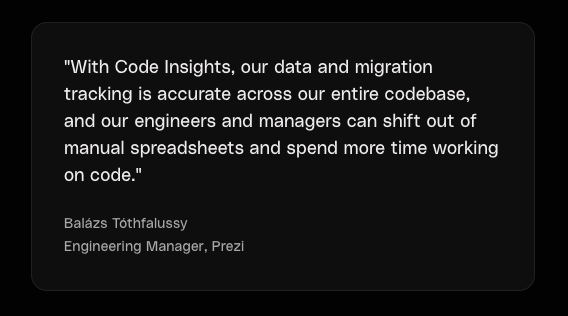
Prezi's engineering team shifted debt tracking from manual spreadsheets to live queries with Code Insights.
You can't manage a portfolio you can't price. Measurement deserves its own deep treatment, but the short version has three layers:
The principle across all three is the same. Measure from the codebase, not from memory, and pick a handful of metrics that prove whether the curve is bending.
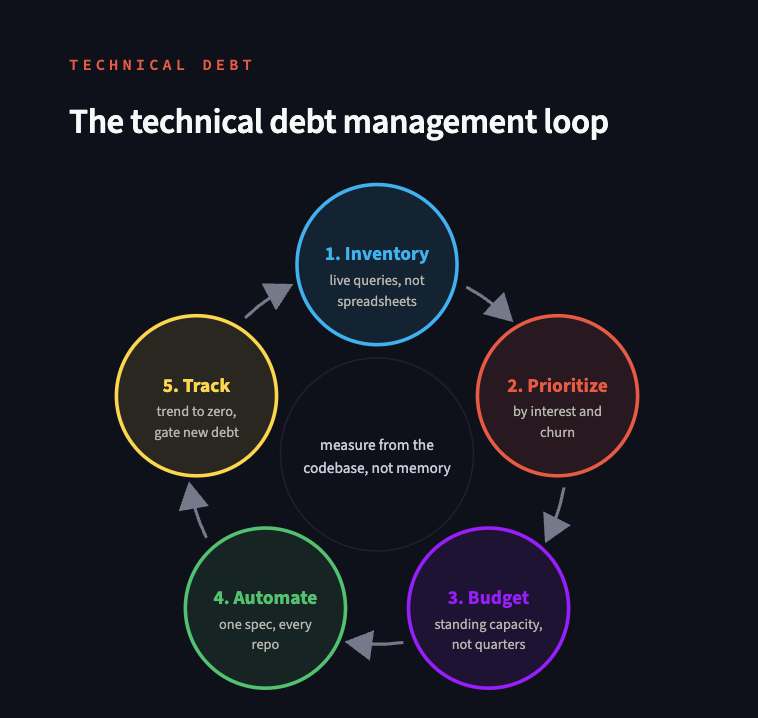
The technical debt management loop: a standing system, not a one-time cleanup.
Replace the audit document with queries. Each known debt item becomes a search: every usage of the legacy HTTP client, every service still on the old framework version, every @deprecated call. Sourcegraph's Code Insights was built for exactly this, turning the codebase into a queryable database and charting patterns such as deprecated calls or vulnerable Log4j versions over time. The inventory now updates automatically, and disagreements about scope become lookups rather than debates.
The quadrant model earns its keep here. Score each debt item on two practical dimensions: how much interest it charges (incidents caused, delivery drag, security exposure) and how often the surrounding code changes. High-interest, high-churn debt goes to the top. Big-but-dormant debt, the kind that makes audits look scary, often belongs at the bottom. This is also where the 80/20 intuition applies, since a small fraction of debt items typically generates most of the pain, and finding that fraction is the whole game.
Here's a worked example. Suppose the inventory shows 4,100 references on a deprecated internal HTTP client, 60 services on an end-of-life framework version, and a sprawling God-class in the billing service. The framework EOL wins, because it charges interest in the form of unpatched CVEs and blocks other upgrades. The God-class comes second if billing changes weekly, and the 4,100 references might rank last despite the scary number, because the old client still works and a mechanical migration can be automated later. Size made the references look urgent; interest says otherwise.
A fixed, predictable allocation (many teams land between 10% and 30% of capacity) outperforms heroic quarters by surviving roadmap negotiation. The budget is easier to defend when step 1 gives you charts. Using the worked example above, "we spent 20% of capacity, and the deprecated-API count dropped from 4,100 to 900" is a renewal argument, not a plea. SEI's organizational research points in the same direction; their recommendations for managing technical debt focus on making debt management a standing practice with policy and visibility behind it, not a one-off initiative.
Two budget mechanics are worth stealing. First, attach paydown to feature work where possible. If a team is shipping a feature in the billing service anyway, the God-class refactor rides along at a discount, because the context-loading cost is already paid. Second, ring-fence a small slice for opportunistic fixes (the Boy Scout rule, systematized) so engineers don't need permission for sub-day improvements. The standing budget covers planned campaigns, and the slice covers entropy.
Manual paydown doesn't scale past a handful of repos. When the fix is mechanical (replace the import, bump the version, swap the API call), automation turns months into days. Batch Changes runs a change across every affected repository from one declarative file and tracks the changesets through review to merge, which is precisely the "pay down tech debt across all of your repositories" job it's positioned for. The same applies to codemod engines for language-specific transforms. The win isn't only speed, because an automated change is also consistent, reviewable, and doesn't burn out the engineer assigned to it.
The last step closes the loop. The dashboards from step 1 become the program's scoreboard, reviewed at the same cadence as delivery metrics. Add prevention gates where they pay off, like CI checks that block new usages of a deprecated pattern while the count trends to zero. Scale matters here, too. CERN's accelerator-controls codebase grew to roughly 15 million lines of Java code over 18 years, and their nearly 300 developers use Sourcegraph Code Search to spot duplication and reduce technical debt as part of their normal work rather than as an annual event. That's the end state worth aiming for, debt management as an ambient practice rather than a special project.
No single tool covers the whole loop, and the honest framing is by job:
AI-assisted development can shift the debt equation on both sides. Code generation can increase the volume of code shipped, and, with it, the volume of inadvertent debt if review and measurement don't scale to keep pace. Teams that already struggle to review human-velocity changes will not find AI-velocity changes easier. An analysis in MIT Sloan Management Review of tech debt in the AI era lands on a framing consistent with everything above: that the goal is to manage debt and focus on the highest-value fixes rather than eliminate it.
On the paydown side, AI helps most where the work was always mechanical reading and rewriting, like summarizing unfamiliar modules, drafting characterization tests, or proposing refactors for human review. What AI doesn't change is the need for ground truth. A model can't reliably tell you how many services still call the deprecated API, but a codebase query can, in a way that's auditable. The teams get value-pair generation with verification: AI proposes, and the codebase data confirms.
There's a quieter implication for debt intake, too. When generated code is cheap, the prudent-deliberate quadrant gets crowded. Teams knowingly accept generated scaffolding that works but doesn't match house patterns, planning to clean it up later. That's a rational trade exactly as often as it was in 1992, which is to say only when someone writes down the payoff plan. The intake question for AI-era debt management is the old one at a new volume. Did we take on this debt on purpose, and who is responsible for paying it back?
Technical debt management fails as an act of willpower and works as a system. That system is a live inventory queried from the codebase, prioritization by interest, a standing budget, automated paydown, and a scoreboard that keeps everyone honest. The spreadsheet era of debt tracking ended for the teams that adopted that loop, and their debt conversations now start with a chart rather than a feeling.
If your debt register is a document nobody trusts, start by making it queryable. See how Code Insights turns debt tracking into live data from your own codebase.
What is tech debt management? The ongoing practice of identifying, measuring, prioritizing, and paying down technical debt while controlling new debt intake. Done well, it's a standing system with live metrics and a budget, not a one-time cleanup.
What are the 4 quadrants of technical debt? Fowler's quadrant crosses deliberate vs. inadvertent with prudent vs. reckless, producing four kinds of debt that warrant different responses, from scheduled payoff (prudent-deliberate) to containment and rebuild (reckless).
What are the 4 types of technical debt? Taxonomies vary by source, but the categories most teams track are code debt, architecture debt, testing debt, and documentation debt, with security and infrastructure debt often split out separately. The quadrant describes how debt was incurred; type taxonomies describe where it lives.
What is the 80/20 rule for technical debt? The observation that a small share of debt items causes most of the drag, since a handful of high-churn, high-complexity hotspots typically account for the bulk of incidents and slowdowns. It argues for prioritizing by measured interest rather than by total debt size.

With Sourcegraph, the code understanding platform for enterprise.
Schedule a demo